

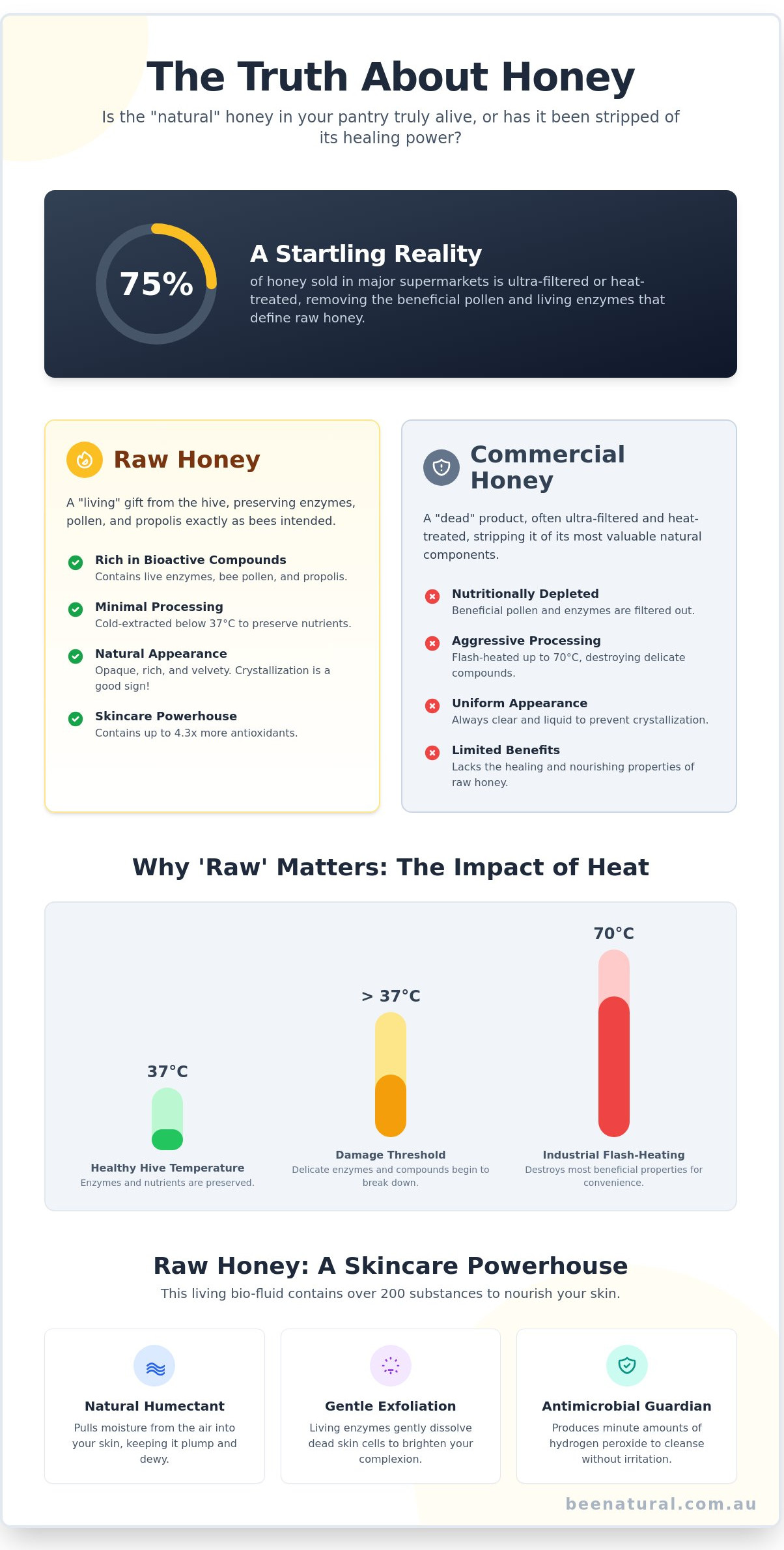
What if the golden liquid sitting in your pantry is technically "dead" before it even touches your tea? It's a startling reality that 75% of honey sold in major supermarkets has been ultra-filtered or heat-treated, effectively stripping away the medicinal pollen and living enzymes that make raw honey a true gift from the hive. You likely reach for that bottle because you value purity and health, yet many "natural" labels are designed to mislead, leaving those with sensitive skin or health goals feeling frustrated and disconnected from the source.
We believe there's a more honest way to nourish your body and soul. In this guide, we'll give you the confidence to identify genuine, handcrafted honey and explain how its velvety texture and bioactive compounds can transform your skincare ritual. You'll discover how to support sustainable Australian beekeeping while learning about the specific 2026 standards for purity. From the aromatic blossoms of the Australian bush to your morning routine, we're sharing everything you need to know about this soothing, living gold.
Key Takeaways
- Discover why raw honey is considered a "living" ingredient, preserving the vital enzymes, pollen, and propolis exactly as the bees intended.
- Learn how the natural humectants and gentle enzymes found in the hive draw moisture into your skin for a velvety, nourished complexion.
- Understand the industrial processes that strip commercial honey of its benefits and how to identify the rich, opaque texture of true quality.
- Master simple at-home tests to verify purity and learn why crystallisation is a natural sign of a pure, unheated product.
- Connect with the "slow" artisanal philosophy and sustainable Australian beekeeping practices that have defined our handcrafted care since 1992.
What is Raw Honey? Understanding the Essence of the Hive
Raw honey is the pure, unfiltered essence of the Australian bush, captured exactly as our bee partners intended. Unlike the clear, liquid syrups found on many supermarket shelves, true raw honey remains untouched by high heat or fine pressure filtration. It's a living, breathing gift from the hive. This golden substance retains its natural integrity, carrying within it a complex tapestry of enzymes, local pollen, and propolis. For over 5,000 years, humans have turned to this botanical treasure as a soothing remedy for both internal health and radiant skin. To truly understand What is Raw Honey?, one must look past the jar and into the heart of the hive itself. It's a seasonal masterpiece that varies in scent and texture depending on which native gums are in bloom.
Every jar of authentic raw honey contains:
- Live Enzymes: Proteins that aid digestion and support biological activity.
- Bee Pollen: A nutrient-dense source of vitamins and amino acids.
- Propolis: A protective resin with natural antimicrobial properties.
The Journey from Blossom to Comb
Bees forage across thousands of native blossoms, from the rugged Jarrah to the aromatic Manuka, collecting nectar and mixing it with special enzymes. Back at the hive, they fan their wings with tireless dedication to reduce moisture levels. They stop only when the honey reaches a stable 18 to 20 percent water content. Once perfected, the bees seal each cell with a delicate wax cap. This natural seal preserves the honey's vitality for years. While industrial methods often involve mass blending and flash-heating to 70°C for speed, artisanal beekeeping focuses on small, handcrafted batches. We wait for the bees to finish their work. This ensures every spoonful reflects the unique floral signature of the Australian landscape.
Why 'Raw' Matters: The Preservation of Vitality
The magic of the hive is fragile. When honey is heated above 37°C, the internal temperature of a healthy hive, its delicate enzymes and aromatic compounds begin to break down. We use a cold-extraction process to ensure these life-giving properties remain intact. This method prioritizes quality over the convenience of fast-flowing, heated honey. It keeps the honey's velvety texture and soothing aroma exactly as it was in the comb. Raw honey is a bioactive substance that remains chemically alive and potent until the moment it is consumed or applied to your skin. It's an uncomplicated, honest product that respects the hard work of the colony and the health of your family.
The Living Chemistry: Why Raw Honey is a Skincare Powerhouse
Raw honey is far more than a simple sweetener; it's a complex, living bio-fluid that contains over 200 distinct substances. These include amino acids, vitamins, and minerals that closely mirror the nutritional needs of our own skin. As a natural humectant, raw honey possesses the unique ability to pull moisture from the atmosphere directly into the dermal layers. This process keeps your complexion plump and dewy for hours. Our tiny winged partners also infuse this golden liquid with glucose oxidase. This specific enzyme acts as a gentle, slow-release guardian. It provides antimicrobial protection by producing minute amounts of hydrogen peroxide, which cleanses the skin without the irritation often caused by synthetic alternatives. By neutralizing free radicals, the rich array of antioxidants in the honey helps shield your surface cells from environmental stressors. We view this as bee-driven skincare. It's a philosophy that respects your body's natural healing rhythm rather than forcing a chemical change.
Enzymes and Phytonutrients for Skin Repair
Living enzymes like invertase and diastase don't just sit on the surface. They work to gently dissolve dead skin cells, offering a soft exfoliation that brightens your complexion without the need for harsh scrubs. Phenolic compounds, the plant-based powerhouses gathered by bees from Australian blossoms, help soothe redness and calm persistent inflammation. These benefits are most potent in honey skincare products that are handled with care to preserve these delicate, heat-sensitive molecules. Research indicates that raw varieties can contain up to 4.3 times more antioxidant activity than processed versions, making them essential for genuine skin repair.
Propolis and Pollen: The Hidden Healers
Inside every jar of truly raw honey, you'll find microscopic traces of propolis and bee pollen. Propolis acts as a natural glue within the hive, and on the skin, it helps to seal the moisture barrier and repair micro-damage. Many people don't realize that standard supermarket options are often high-pressure filtered. This process removes these vital botanical particles to create a clearer liquid. When comparing Raw vs. Commercial Honey, the difference in nutrient density is significant; raw varieties retain their full pollen profile, whereas commercial processing can strip away these elements entirely. Bee pollen provides a concentrated burst of nourishment, containing 22 amino acids and 18 vitamins that support skin elasticity. Choosing handcrafted hive treasures ensures these healers stay right where they belong. This back-to-basics approach allows the skin to thrive on the pure, unadulterated gifts of the Australian landscape.
Raw vs. Commercial Honey: A Comparison of Quality
When you hold a jar of commercial honey up to the light, it often looks like polished amber glass. It is perfectly clear, perpetually runny, and uniform. This aesthetic perfection is a sign of a heavy industrial hand. In contrast, raw honey is a living, textured treasure. It is often opaque or creamy, filled with tiny flecks of pollen and propolis that tell the story of the Australian bush.
Commercial producers value shelf life over substance. They use high-heat pasteurisation to ensure the honey never crystallises, keeping it liquid for years in a pantry. While this makes it easier to squeeze from a plastic bottle, it strips away the very essence of what the bees created. This mass-production mindset treats the hive as a factory line, whereas artisanal beekeeping views the bees as vital partners in a delicate ecosystem.
The Impact of High-Heat Pasteurisation
The heating process is the most significant divider between quality and commodity. Once honey is heated above 45°C, its delicate biological structure begins to collapse. The heat destroys the heat-sensitive enzymes that provide the most celebrated raw honey benefits, such as antibacterial properties and digestive support.
This intense heat also changes the chemical makeup, breaking down complex natural sugars into a simpler, less nutritious syrup. To achieve that crystal-clear look, commercial honey undergoes ultra-filtration. This process removes virtually every trace of pollen. Without pollen, it's nearly impossible to verify the honey's origin, which allows for the blending of low-quality syrups from multiple countries. You also lose the volatile aromatic compounds. These are the scents of the eucalyptus and banksia that give Australian honey its soul. When you heat the honey, those aromas simply evaporate into the factory air.
Identifying the 'Real Deal' on the Shelf
Finding authentic honey in a crowded market requires a keen eye for detail. The label is your first line of defence against mass-produced substitutes. It's about looking past the marketing and finding the truth of the harvest.
- Look for terms like 'unpasteurised,' 'raw,' or 'cold-pressed.'
- Check the origin carefully. A 'blend of local and imported ingredients' is a major red flag for quality and transparency.
- Look for a textured appearance. Real honey should look like it came from a hive, not a refinery.
Choosing products that prioritise integrity ensures you aren't just buying a sweetener, but a piece of the natural world. This philosophy is at the heart of our work. We encourage you to explore by nature products that focus on the simple, potent beauty of handcrafted ingredients. Artisanal beekeeping respects the slow pace of the seasons, ensuring every jar remains a nourishing, botanical gift from the hive to your home.
How to Identify and Care for Your Raw Honey
True raw honey is a living, breathing reflection of the landscape. When you open a jar, you shouldn't just smell sugar. You should encounter a complex, floral bouquet that whispers of eucalyptus, banksia, or wildflower. To ensure your honey is the real deal, try the thumb test. Place a small drop on your thumbnail; pure honey stays in a thick, rounded bead, while diluted syrups will run. Another reliable method is the water test. Drop a teaspoon into a glass of room-temperature water. Raw honey sinks to the bottom as a solid lump, whereas processed versions begin to dissolve immediately.
Preserving these delicate enzymes requires mindful storage. Keep your jars in a cool, dark pantry away from direct sunlight. Always use a clean, dry spoon to prevent moisture from entering the jar, as even a small amount of water can trigger fermentation. Avoid high heat at all costs. Temperatures above 40 degrees Celsius will effectively "cook" the honey, destroying the very minerals and antioxidants you're looking for. When handled with respect, your honey can last for years without losing its vitality.
The Truth About Crystallisation
Don't worry if your honey turns cloudy or firm. This is crystallisation, a natural process that proves your honey hasn't been over-filtered or heat-treated. It happens when the glucose separates from the water, forming tiny crystals. Honey with higher glucose ratios, like many Australian bush varieties, will set faster than those high in fructose. If you prefer a liquid state, place the jar in a bowl of warm water (under 40°C) and wait. Alternatively, embrace the texture. The velvety, fine-grained feel of set honey makes a nourishing skin mask that stays in place while it hydrates.
Sustainability and the Australian Landscape
Choosing local honey is a direct vote for the health of our continent. Australia is home to some of the world's most unique floral sources, from the ancient Jarrah forests to the flowering gums of the Great Dividing Range. Our bees act as vital pollinators for this biodiversity. Areas like beechworth australia have served as the historic heart of beekeeping since the mid-1800s, fostering a culture of artisanal care. By supporting these local apiaries, you help maintain the bee populations that keep our ecosystems resilient. It’s a beautiful cycle of giving back to the earth that provides for us.
Ready to experience the difference of hive-to-home purity? Explore our range of raw honey and botanical skincare.
The Bee Natural Philosophy: From Hive to Hand
Since 1992, we've followed a rhythm set by the wings of our bees. Our philosophy is simple. We believe that skincare should be a gentle extension of the natural world. This means we embrace a "slow" approach to production. We don't force the hives to produce more than they're able, and we don't rush the curing of our balms. Instead, we allow nature to dictate the pace of our work. This patience results in a product that feels living and vibrant. The synergy between raw honey, beeswax, and propolis is the cornerstone of our formulas. Honey provides deep hydration. Beeswax creates a breathable, velvety barrier. Propolis offers a concentrated boost of antioxidants. Together, they form a nurturing trifecta that supports the skin's natural ability to heal and glow.
Our work is a partnership with the environment. We treat the bees as vital collaborators rather than a resource to be exploited. This respect flows through every stage of our process, from the way we harvest to the way we package our finished goods. By keeping our formulations uncomplicated, we allow the aromatic scents of Australian flora to shine through. You won't find synthetic fragrances or harsh fillers here. We rely on the botanical wisdom of the landscape to provide everything the skin needs to thrive.
Small-Batch Integrity and Nurturing Formulas
We still hand-pour our creams in small batches to maintain total control over quality. This human touch ensures that no jar leaves our workshop without being checked by a person who cares. We keep our ingredients at low temperatures. This protects the delicate nutrients in the raw honey, ensuring they reach your skin in their most potent, bioactive state. You can learn more about this dedicated artisanal process by reading bee from bee, which chronicles our journey from the hive to excellence. Our methods haven't changed much in 34 years because we know that the old ways are often the best ways for the planet.
Your Invitation to Hive-Based Wellness
If you struggle with dry or sensitive skin, the hive offers a soothing solution. Our formulas provide a gentle alternative to the chemical-heavy products found on most modern shelves. We encourage you to move toward a more mindful beauty routine. This is a choice that values the health of your skin and the preservation of the Australian environment. Every purchase supports the bees that pollinate our native flora. We invite you to explore our handcrafted range of raw honey skincare today. Experience the difference of skincare made with a deep, abiding respect for the living gold of the hive.
Embrace the Living Gold of the Hive
Choosing raw honey means choosing a living ingredient that remains exactly as the bees intended. You've learned that its true value lies in the delicate enzymes and botanical compounds that commercial heat processing often destroys. Whether you're using it to soothe your skin or looking for that telltale cloudy texture of authenticity, this golden nectar is a gift from our local landscape. Since 1992, we've remained dedicated to the artisanal process of beekeeping and skincare. Every jar and balm we create is handmade in small batches to ensure the integrity of our sustainably sourced Australian ingredients. We've been a trusted part of Australian homes for over 30 years because we believe in slow, honest production that respects our winged partners. It's time to bring that same gentle, nourishing care into your daily ritual and feel the difference of pure, velvety botanicals. Your skin deserves the honesty of nature, and our bees are ready to share their work with you.
Discover the nurturing power of raw honey in our handcrafted skincare range
Let the wisdom of the hive transform your well-being today.
Frequently Asked Questions
Is raw honey safe to use directly on the skin?
Yes, you can apply raw honey directly to your skin as a nourishing, velvety mask. Its natural pH sits between 3.9 and 4.5, which perfectly mirrors your skin's protective acid mantle. This golden nectar contains living enzymes that gently exfoliate without the harshness of chemicals. Simply smooth a teaspoon over your face, leave it for 15 minutes, and rinse with warm water to reveal a soft, hydrated glow.
How can I tell if my honey is actually raw and not just labelled that way?
You can identify authentic raw honey by its opaque appearance and the presence of tiny pollen specks or wax particles. Unlike clear, factory-filtered syrups, our honey retains over 200 distinct compounds that provide its medicinal depth. If your jar remains perfectly liquid and transparent for years at room temperature, it's likely been ultra-filtered or heated above 45°C. Check the label for 100% Australian origin to ensure you're supporting local hives.
Why has my raw honey turned hard or cloudy?
Cloudiness and hardening are natural signs that your honey is alive and unprocessed. This process, called crystallization, occurs when glucose separates from water and forms tiny crystals, especially when temperatures drop below 14°C. It doesn't mean your honey is spoiled; it actually proves the honey hasn't been pasteurized. To return it to a liquid state, gently place your jar in a bowl of warm water around 40°C and wait patiently.
Does raw honey expire or go bad over time?
Pure raw honey doesn't expire and can remain edible for centuries if kept in a sealed glass jar. Its incredible longevity comes from a low moisture content of less than 18% and a naturally acidic environment that prevents spoilage. Archaeologists famously discovered 3,000-year-old honey in Egyptian tombs that was still perfectly safe to eat. Just keep the lid tight to prevent the golden liquid from absorbing moisture from the Australian humidity.
What is the difference between raw honey and Manuka honey?
Raw honey is a general term for any honey that hasn't been heated, while Manuka is a specific variety harvested from the Leptospermum tree. While all our honey is raw and nourishing, Manuka is prized for its high levels of Methylglyoxal (MGO). In Australia, we measure this potency carefully, with medicinal grades often exceeding 500 MGO. Think of raw honey as the beautiful family, and Manuka as a specialized member with unique antibacterial strengths.
Can raw honey help with specific skin conditions like eczema or acne?
Raw honey works wonders for eczema and acne by acting as a natural humectant that draws moisture into the skin. Its antibacterial properties help clear pores, while its anti-inflammatory nature can reduce acne redness by up to 50% in 48 hours. By creating a protective barrier, it allows the skin to heal itself in a calm, hydrated environment. It’s a gentle, botanical alternative to synthetic creams that often strip your skin’s natural oils.
Why is raw honey more expensive than supermarket honey?
You’ll notice raw honey costs more because it’s a handcrafted product that respects the slow pace of the bees. While mass-produced supermarket honey might sell for A$8 per 500g, premium raw honey usually ranges from A$20 to A$45 per jar. This price reflects the cost of cold-extraction, small-batch bottling, and ensuring our beekeepers receive a fair wage. It’s an investment in the health of our Australian environment and the survival of our bees.
Is raw honey safe for children and infants?
Raw honey is perfectly safe for adults and children over the age of 12 months. You must never give honey to infants under one year old because their digestive systems aren't yet developed enough to handle certain spores. These spores can lead to infant botulism, a rare but serious condition affecting roughly 1 in 100,000 babies. Once your little one reaches their first birthday, they can safely enjoy the wholesome sweetness and nutrients found in the hive.