

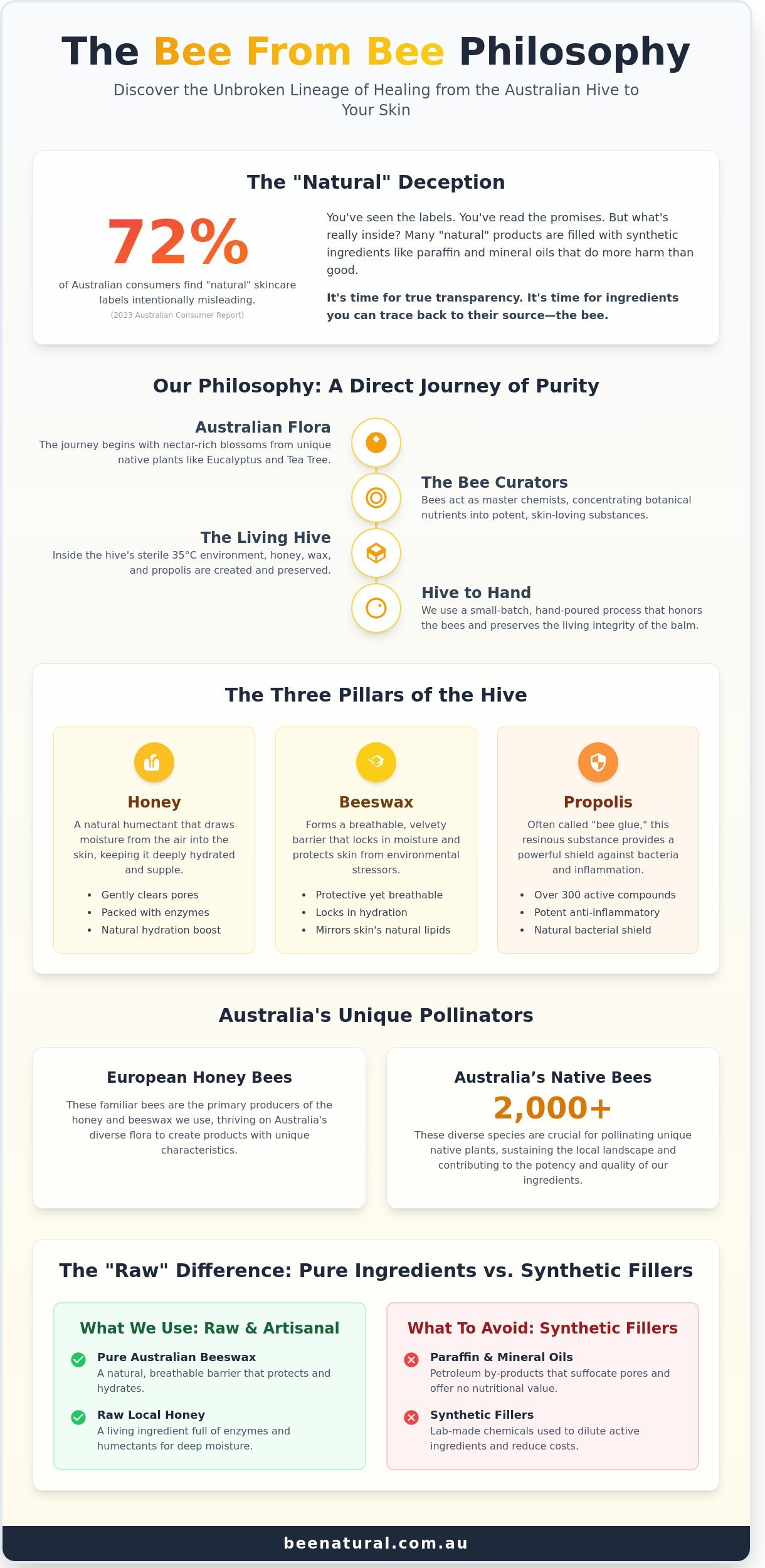
What if the secret to healing your dry skin isn't found in a sterile laboratory, but inside the golden geometry of a local Australian hive? You've likely felt the frustration of reading "natural" on a bottle only to find a list of synthetic fillers that leave your skin feeling as parched as the Simpson Desert in January. According to a 2023 Australian consumer report, 72% of shoppers find these vague skincare labels intentionally misleading. This is where the bee from bee philosophy changes everything, grounding your daily ritual in the authentic, rhythmic work of our buzzing partners.
We understand that you want a velvety, soothing solution that doesn't compromise your values or the safety of our pollinators. You deserve to know that your nourishing balm was hand-poured in a small batch rather than mass-produced in a cold factory. In this article, you'll discover the profound connection between bee biology and artisanal skincare, and why the specific source of your wax determines your skin's health. We'll walk through the entire hive-to-skin process so you can identify truly pure ingredients and support ethical beekeeping with every purchase.
Key Takeaways
- Learn how the golden humectants in honey and the protective barrier of beeswax work together to naturally nourish and soothe your skin.
- Understand the bee from bee philosophy, tracing the direct journey of pure ingredients from the hive to your hand to ensure maximum healing potency.
- Discover the unique roles of European honey bees and Australia’s 2,000 native bee species in sustaining our local landscape and skincare quality.
- Gain the confidence to identify raw, artisanal ingredients on labels, helping you avoid hidden synthetic fillers like paraffin and mineral oils.
- Explore why small-batch, hand-poured production in Byron Bay honors the bees as partners and preserves the living integrity of every botanical balm.
What Does "Bee from Bee" Really Mean? The Source of Life and Healing
At its heart, the concept of bee from bee represents an unbroken lineage of healing. It's a philosophy that ensures the ingredients in your skincare remain exactly as the hive intended, without the interference of heavy industrial processing or synthetic dilution. When we talk about this direct connection, we're describing a raw, tactile journey from the nectar-rich blossoms of the Australian landscape straight to your skin. This approach prioritises the living energy of the hive, acknowledging that the bees are the ultimate artisans of the botanical world. In the lush coastal environment of Byron Bay, where biodiversity is a way of life, this transparency isn't just a choice; it's a commitment to the integrity of the local ecosystem.
The symbiotic relationship between bees and the Australian bush is a masterpiece of natural engineering. Australia is home to over 2,000 species of native bees, each playing a critical role in pollinating the unique flora that makes our continent's honey and wax so potent. This relationship creates a feedback loop of health. As bees gather nutrients from native eucalyptus and tea trees, they concentrate the medicinal properties of these plants into substances that offer profound benefits for human skin. We don't see the bees as a resource to be exploited, but as partners in a slow, careful dance that produces the world's most nourishing skincare foundations.
To understand the potency of these ingredients, we look toward the three pillars of the hive:
- Honey: A natural humectant that draws moisture from the air into the skin, packed with enzymes that gently clear pores.
- Beeswax: This creates a breathable, velvety barrier that protects against environmental stressors. Understanding Beeswax composition and uses reveals how its complex esters and fatty acids mirror the skin's natural lipids, making it an ideal carrier for hydration.
- Propolis: Often called "bee glue," this resinous substance contains over 300 individual compounds, providing a powerful shield against bacteria and inflammation.
The Evolution of the Vegan Wasp
The story of our ingredients began 150 million years ago. During this period, certain predatory wasps underwent a radical transformation, moving away from hunting other insects to gathering pollen. These "vegan wasps" developed specialized branched hairs, known as plumose hairs, specifically designed to trap and carry botanical proteins. This evolutionary shift turned bees into the ultimate curators of the plant kingdom. They don't just collect nectar; they select the most nutrient-dense elements of the flora, concentrating botanical life into the golden substances we use in our handcrafted formulations today.
The Hive as a Living Laboratory
Inside the hive, a miraculous process of preservation takes place. The bees maintain a constant temperature of approximately 35 degrees Celsius, creating a sterile environment that is more sophisticated than many modern laboratories. Every substance produced here is designed to protect, nourish, and heal the colony. Our Bee Natural philosophy respects this laboratory by interfering as little as possible. We believe that the hive already holds the answers to skin health. By maintaining the bee from bee connection, we ensure that the protective, anti-inflammatory, and regenerative properties of the hive arrive at your door in their most active, honest form.
The Alchemy of the Hive: How Bees Create Nature’s Skincare Gold
Our little partners, the bees, are master chemists. They transform the nectar of Byron Bay's lush coastline into substances that our skin recognizes and loves. It is a gift passed directly bee from bee, ensuring that every drop of nourishment remains intact. This process isn't just about gathering ingredients; it is a slow, rhythmic transformation that happens inside the hive. When we harvest these elements, we do so with a deep respect for the time it took to create them. Each substance serves a vital purpose for the bee colony, and those same properties offer profound benefits for our own skin health.
Honey is perhaps the most famous of these treasures. It acts as a powerful humectant, which means it has the unique ability to draw moisture from the surrounding air and lock it into the dermis. This keeps your skin hydrated and plump without the need for synthetic fillers. Beyond hydration, the hive provides propolis, often called "bee glue." This resinous mixture is used by bees to seal cracks in the hive and keep it sterile. For us, propolis acts as a potent antimicrobial agent. A Scientific review of bee products in dermatology highlights how these complex compounds support wound healing and reduce inflammation. Then there is royal jelly, the nutrient-dense food reserved for the queen. It is packed with 10-HDA, a unique fatty acid that encourages collagen production and skin rejuvenation.
Raw Honey vs. Commercial Honey
The difference between what you find on a supermarket shelf and what comes from a local Byron hive is vast. Most commercial honey is pasteurised at temperatures exceeding 70°C to prevent crystallisation and ensure a clear, liquid look. This heat destroys delicate enzymes like glucose oxidase, which is responsible for honey's natural antibacterial properties. Raw honey is a living ingredient harvested with minimal interference. Because we don't heat-treat our honey, the living enzymes remain active and ready to heal your skin. The local flora of the Northern Rivers, including Tea Tree and Eucalyptus, further infuses our honey with specific antioxidants that protect against environmental stressors found in the Australian climate.
Beeswax: The Breathable Shield
Beeswax is a structural marvel. Worker bees produce this wax from special glands on their abdomens, consuming roughly 8kg of honey to produce just 1kg of wax. This precious substance creates the physical home for the colony, but on your skin, it performs a different miracle. Unlike petroleum-based waxes or paraffin that sit like a plastic film on the skin, beeswax is "ductile" and breathable. It creates a protective barrier that shields you from wind and pollutants while still allowing your skin to respire and sweat naturally. It doesn't clog pores; it supports them. This makes it the perfect, velvety base for our Original Face Cream, providing a soothing texture that stays with you throughout the day.
If you are looking to simplify your routine, you might enjoy exploring our range of hand-poured skincare essentials that celebrate these raw hive ingredients. We believe that when you stay close to the source, your skin feels the difference immediately.
Australian Native Bees vs. Honey Bees: A Local Byron Bay Perspective
The European Honey Bee arrived on Australian shores in 1822 aboard the ship Isabella. While these golden workers are famous across the globe, they're actually newcomers to the Byron Bay hinterland. Our local landscape was already home to over 2,000 species of Australian native bees. These tiny, often solitary creatures have been part of the ecosystem for millions of years, acting as the quiet guardians of our bushland. This long history matters because the separation of Gondwana 180 million years ago allowed our flora and fauna to evolve in total isolation. Our bees developed alongside ancient plants, creating a symbiotic relationship that produces unique botanical compounds found nowhere else on Earth.
When we source ingredients, we see the wisdom passed down from bee from bee across generations of hive life. The compounds they collect from ancient Eucalyptus and Lemon Myrtle trees carry potent antimicrobial properties. A Scientific review on bee products in dermatology highlights how these natural substances support skin barrier repair and reduce inflammation. In Byron Bay, the bees forage on plants that have adapted to our specific coastal soil and humid climate. This results in beeswax and honey with a rich, complex chemical profile that feels velvety and nourishing on the skin. This intricate process of sharing resources, passed from bee from bee, creates the potent propolis we use in our artisanal formulations.
Native Stingless Bees (Tetragonula)
These tiny, dark bees are the stars of the subtropical north. They produce a rare substance called "sugarbag" honey. It’s distinctively citrusy, tangy, and contains higher levels of phenolic antioxidants than traditional honey. Because these bees are small, they can access delicate flowers that larger bees ignore. This unique foraging habit promotes incredible biodiversity in the Byron Bay hinterland. We treat these native colonies with deep reverence. Their contributions to artisanal skincare are precious and highly prized for their ability to soothe sensitive skin naturally. Since they only produce tiny amounts, every drop is treated as a gift from the landscape.
A Comparison of Hive Outputs
The differences in hive output are staggering. A single European honey bee hive can produce 50 kilograms of honey in a good season. In contrast, a native stingless bee colony might only produce 1 kilogram per year. This rarity is why native bee products are so special in small-batch production. Native honey is thinner, more acidic, and naturally infused with propolis from the hive structure itself. At Bee Natural, we support both species to ensure a healthy local ecosystem. We avoid industrial honey farming methods that often prioritize volume over the well-being of the insects. Our practices focus on the slow, careful collection of materials, ensuring the bees have more than enough left for themselves. This neighborly approach to beekeeping creates a product that is pure, ethical, and deeply connected to the Australian earth.
The "Raw" Difference: Choosing Pure Bee Products Over Synthetic Alternatives
You can tell the difference the moment a tin opens. The air fills with the faint, sweet scent of sun-drenched wildflowers and warm honey, a sensory signature that synthetic fragrances simply can't replicate. Mainstream skincare often relies on "parfum," a catch-all term that a 2024 report suggests can hide over 3,000 different chemicals, many of which are known skin irritants. These lab-made scents don't offer any healing properties; they merely mask the chemical odor of the petroleum-based fillers that make up the bulk of mass-produced creams.
Mainstream brands frequently use mineral oils because they're cheap and have an indefinite shelf life. However, these oils are refined crude oil byproducts that sit on top of the skin, clogging pores and preventing it from breathing. Reading a label shouldn't require a chemistry degree. If you see "Paraffinum Liquidum" or "Petrolatum," you're applying a plastic-like barrier. In contrast, real beeswax, or Cera Alba, is a living substance. The integrity of a bee from bee extract is unmatched because it allows your skin to respire while providing a breathable, protective layer that locks in moisture naturally.
Natural products have a shorter, more honest shelf life, and that's actually a badge of honor. A cream that stays "fresh" on a shelf for five years is likely packed with parabens and synthetic stabilizers that keep the product "biologically dead." Most of our handcrafted balms are best used within 12 months of opening. This ensures you're applying active, potent ingredients to your face rather than a cocktail of preservatives. This purity is why a bee from bee creation feels so different on the fingertips; it's velvety, rich, and absorbs with a familiar ease that your body recognizes.
The Problem with Mass Production
Industrial processing is the enemy of healing. To keep up with global demand, large factories often heat their ingredients to over 80 degrees Celsius to speed up mixing. This intense heat strips away the volatile organic compounds and delicate enzymes that make honey and wax so beneficial. These "biologically dead" products lack the soul of the hive. Additionally, the environmental cost of sourcing synthetic alternatives involves heavy chemical refining that pollutes our waterways, a stark contrast to the regenerative nature of local beekeeping.
Healing Common Skin Conditions
Our work at the skin lab has shown that raw propolis is a powerhouse for those struggling with acne or dermatitis. Often called "bee glue," propolis contains over 300 natural compounds that act as an antibacterial shield. For those with eczema, the fatty acids in our beeswax mimic the skin's natural lipid barrier, providing relief where synthetic lotions fail. Small-batch testing ensures that every jar maintains the high potency levels required to soothe inflamed tissues effectively. You don't need a complex routine; you just need ingredients that work in harmony with your biology.
Ready to experience the soothing power of the hive for yourself? Shop our raw, small-batch collection and feel the difference that pure, Australian ingredients make.
From Hive to Hand: Why Small-Batch Artisanal Production Honors the Bee
Since our first jar was filled in 1992, Bee Natural has remained dedicated to the quiet art of hand-pouring in the heart of Byron Bay. For over 32 years, we’ve resisted the urge to scale into a faceless factory. Our workshop is a place of steady, rhythmic work where we treat our bees as respected partners rather than mere resources. This long-standing commitment means we understand the seasonal shifts of the Northern Rivers landscape and how they influence the golden wax and honey we harvest. We don't see our hives as production units; we see every bee from bee colony as a vital contributor to a delicate, living system.
Honouring the life of the bee from bee-centric harvesting to the final pour is what sets artisanal skincare apart. When you choose a product born from this philosophy, you’re participating in a cycle of respect that protects our local environment. We work alongside local Australian beekeepers who share our vision, ensuring that every purchase supports sustainable apiaries that prioritise hive health over high-yield profits. These partnerships are the backbone of our business; they keep our local economy thriving and our ecosystems resilient against the pressures of industrial farming.
Transforming your daily routine from a chore into a ritual of self-care is at the heart of what we do. Skincare is a rare moment to breathe and reconnect with yourself. As you apply a nourishing balm, the aromatic scents of eucalyptus and wild blossoms ground you in the present moment. This isn't just about skin maintenance; it's about honouring your body with ingredients that are as alive and vibrant as the coastal heathlands they came from. It's a daily reminder to slow down and appreciate the simple, raw beauty of nature.
The Small-Batch Philosophy
We are proud members of the slow skincare movement. By producing in limited quantities, we maintain a level of quality control that automated machines simply can't replicate. Our artisans use their senses to judge the perfect temperature for melting wax and the exact moment to blend in our botanical oils. This human touch ensures that every balm is velvety and every cream is potent. Every jar of Bee Natural cream contains the collective work of thousands of bees. We keep our batches small to ensure nothing sits on a warehouse shelf for years losing its vitality. You receive a product that is fresh, active, and filled with the natural energy of the hive.
Sustainability in Every Jar
Our dedication to the planet is visible in every choice we make. We’ve eliminated plastic packaging in favour of glass and metal containers that can be reused or recycled indefinitely. Our ingredients are biodegradable and free from synthetic fillers that harm our precious Australian waterways. To keep our carbon footprint low, we prioritise sourcing ingredients from within the Byron Bay region. This local focus ensures that we aren't shipping heavy raw materials across the globe, reducing transport emissions significantly. When you open a jar, you’re experiencing the best of the Northern Rivers, harvested with care and bottled with integrity.
Ready to experience the soothing power of the hive? Explore our handcrafted bee-to-skin collection and bring the essence of Byron Bay into your daily self-care ritual.
Embrace the Healing Wisdom of the Hive
Choosing skincare shouldn't feel like a clinical chore. It's a return to the simple, golden textures that nature perfected long ago. By selecting raw, living ingredients over synthetic alternatives, you're nourishing your skin with the same vitality found in the hive. Our philosophy of bee from bee ensures that every jar honors the complex relationship between Australian native flora and our industrious winged partners. This isn't mass production; it's a slow, rhythmic craft that respects the earth and your wellbeing.
We've remained dedicated to small-batch artisanal production in Byron Bay since 1992. This commitment keeps the botanical integrity of our formulas intact, ensuring every velvety application feels like a gift from the landscape. For over 30 years, Australians have trusted these hand-poured creations to soothe, protect, and restore. It's time to let your skin breathe and heal with the purity of the Northern Rivers. You deserve a skincare ritual that feels as honest and authentic as the bees themselves. Trust in the power of nature to bring out your most radiant glow.
Experience the healing touch of Byron Bay, Shop our Original Face Cream now
Frequently Asked Questions
What is the difference between bee propolis and honey?
Honey is the bees' primary food source made from flower nectar, while propolis is a resinous "bee glue" used to seal and disinfect the hive. Honey consists of approximately 17 percent water, whereas propolis is a complex mixture of 50 percent resins and 30 percent wax. We use these golden gifts to create nourishing textures that feel velvety and soothing on your skin.
Is beeswax good for sensitive skin and eczema?
Beeswax is exceptionally beneficial for sensitive skin because it forms a non-clogging, breathable barrier that protects against environmental irritants. It has a low comedogenic rating of 2, meaning it won't block your pores while it locks in moisture for up to 12 hours. This natural protection helps calm the redness associated with eczema without the need for harsh synthetic chemicals or artificial fragrances.
Why does Bee Natural use small-batch production?
We choose small-batch production to guarantee that every jar remains fresh and potent for your skin's health. Our Byron Bay team hand-pours limited runs of just 50 units at a time in our local workshop. This artisanal approach reduces our environmental footprint and ensures that the botanical oils don't sit on a warehouse shelf for 12 months before reaching your home.
Are Australian native bees used for commercial skincare?
Australian native bees aren't used for commercial skincare because they produce less than 1 kilogram of honey per year. Instead, we work with European honey bees that provide a sustainable surplus of wax and honey for our formulations. This bee from bee philosophy allows us to protect our 2,000 species of native bees so they can focus on pollinating the local Australian bushland.
What happens to the bees when you harvest their wax and honey?
Our beekeeping partners always leave at least 20 kilograms of honey in the hive to ensure the colony has enough food for the winter months. We follow a gentle bee from bee approach where we only harvest the excess materials that the hive doesn't require for its own survival. This respectful relationship ensures our bee friends stay healthy and productive across every season in the Northern Rivers.
Can I use propolis ointment on open cuts or acne?
You can apply propolis ointment to minor cuts and acne to take advantage of its 300 natural healing compounds. Research indicates that propolis can speed up the skin's recovery process by 25 percent compared to using no treatment at all. Its aromatic, resinous nature creates a soothing environment that helps clear blemishes while keeping the surrounding skin hydrated and soft.
Does natural beeswax lip balm really work better than petroleum jelly?
Natural beeswax lip balm works better than petroleum jelly because it actively nourishes the skin instead of just sitting on top of it. Petroleum is a fossil fuel byproduct, but beeswax is a renewable resource that provides a protective seal for up to 5 hours. It contains vitamin A, which supports cell turnover and keeps your lips feeling supple even in the harsh Australian sun.
How should I store my natural bee products to keep them fresh?
You should store your natural bee products in a cool, dry spot away from direct sunlight at temperatures below 25 degrees Celsius. Because beeswax has a melting point of 62 degrees, keeping it in a dark cupboard helps maintain its smooth, creamy consistency. Following these simple steps ensures your handcrafted balms stay fresh and aromatic for a shelf life of up to 2 years.