

What if the most resilient shield for your complexion wasn't engineered in a laboratory, but gathered by tiny, golden partners from the resinous buds of our native Australian flora? While many people ask, what is propolis, few realize it's an intricate botanical resin containing over 300 bioactive compounds that bees use to seal and sterilize their hives. It's a living, aromatic barrier that has protected bee colonies for over 100 million years, serving as the hive's very own immune system.
You're likely tired of scanning labels only to find a list of confusing synthetic ingredients that fail to soothe your persistent dry skin or redness. It's a common frustration when you simply want an ethical, botanical solution that feels as good as it works. We'll share the ancient secrets of this golden substance, from its protective role in the hive to its extraordinary healing benefits for your face and body. You'll learn the clear differences between honey, beeswax, and this unique resin, while discovering how to use it for deep skin repair with pure, handcrafted products made right here in Australia.
Key Takeaways
- Understand the ancient meaning behind "defense of the city" and discover exactly what is propolis—a golden, resinous gift from our bees to keep the hive safe and sterile.
- Learn how the colony relies on this aromatic botanical glue to create a protected sanctuary, providing a natural form of "social immunity" for the bees.
- Explore the complex blend of resins, waxes, and flavonoids that make this handcrafted substance a powerhouse of protective healing.
- Discover how propolis acts as a soothing shield for your skin, calming redness and offering gentle, antimicrobial support for a clearer complexion.
- Gain confidence in choosing the right artisanal formulations, from velvety balms to lightweight serums, to nourish your daily self-care ritual.
What is Propolis? Understanding the "Glue" of the Hive
Step inside a healthy hive and you'll immediately notice a deep, aromatic scent that lingers in the air. This isn't just the sweetness of honey; it's the earthy, resinous perfume of propolis. To understand what is propolis, think of it as the ultimate protective sealant. It's a complex, resinous mixture that honey bees collect from tree buds, sap flows, and other botanical sources to maintain the integrity of their home.
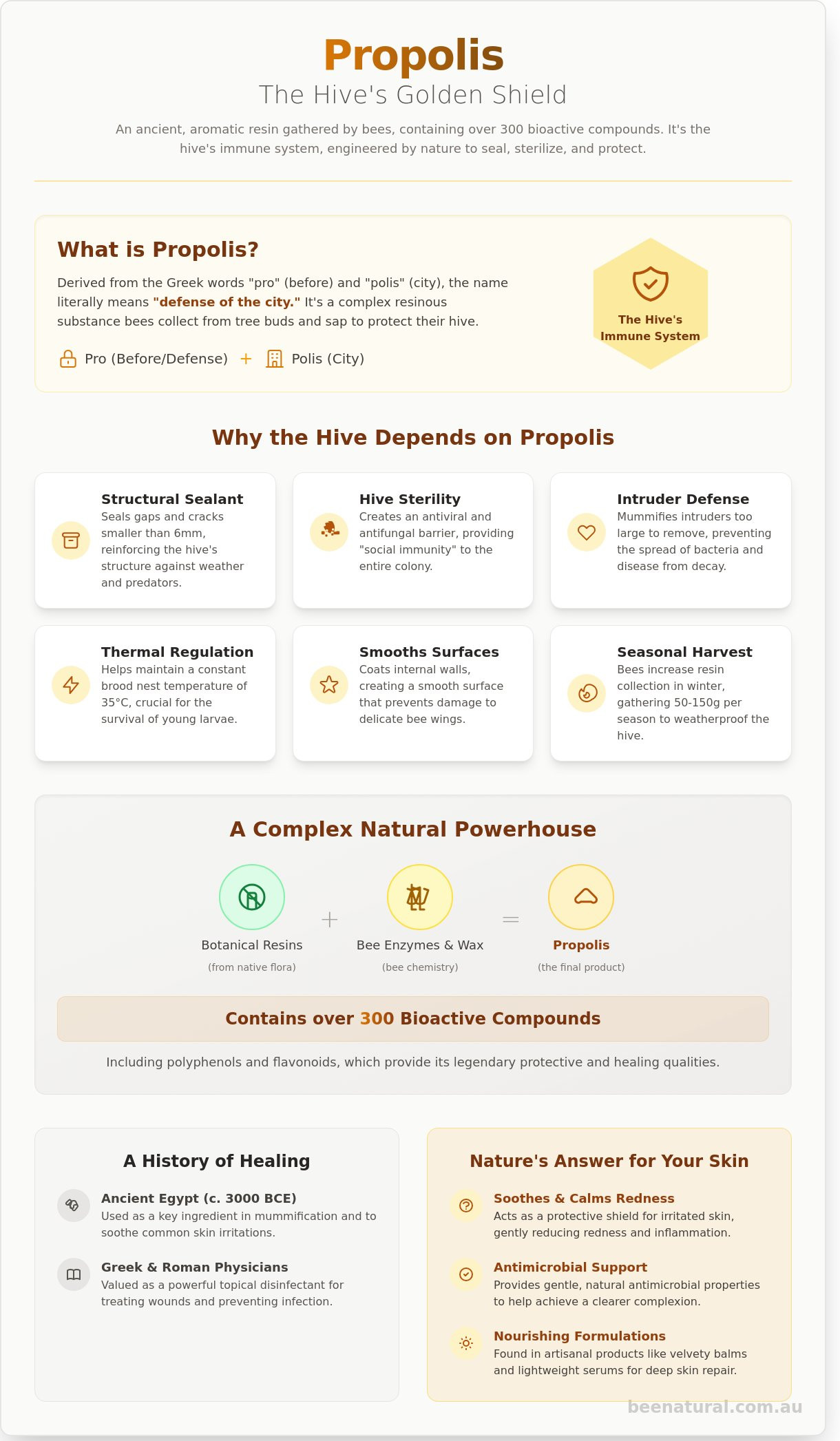
The name itself reveals its vital purpose. Derived from the Greek words "pro" (before) and "polis" (city), it literally translates to "defense of the city." While honey provides the colony with life-giving energy and beeswax forms the physical walls of the comb, propolis serves as the hive’s immune system. It seals small gaps, reinforces the structure, and creates a sterile environment that keeps the colony safe from external threats. This golden-to-dark-brown substance is tacky when warm and brittle when cool; it acts as a living shield for our buzzing partners.
The Origin Story: From Botanical Resins to Bee Chemistry
Our clever bees forage across the Australian landscape, selecting specific resins from native flora and deciduous trees known for their hardy survival traits. Once they've gathered these raw materials, the "bee chemistry" begins. The foragers carry the resin back to the hive where it's mixed with specialized enzymes and small amounts of beeswax to create a potent, shelf-stable material. Propolis is a remarkably complex bio-substance that contains over 300 active compounds, including polyphenols and flavonoids that provide its legendary protective qualities.
A Brief History of Propolis in Traditional Healing
Humans have sought the benefits of this "bee glue" for thousands of years. In ancient Egypt, as early as 3000 BCE, propolis was a key ingredient in the mummification process and was frequently applied to soothe skin irritations. Later, Greek and Roman physicians used it as a topical disinfectant to treat wounds and infections. We bridge this historical wisdom with modern skincare by handcrafting products that bring these raw, botanical benefits directly to your daily ritual. Learning what is propolis allows us to appreciate how ancient knowledge and honey bee ingenuity work together to nourish our skin naturally.
The Biological Purpose: Why the Hive Depends on Propolis
To understand what is propolis, we must view the hive as a living, breathing sanctuary. Our bee partners don't just forage for nectar; they carefully seek out resins from the bark and buds of local Australian trees like the Marri and Jarrah. They blend these botanical juices with beeswax and enzymes to create a powerful, aromatic glue. This sticky substance seals gaps smaller than 6 millimetres, ensuring the hive remains a fortress against the elements. Learning what is propolis helps us appreciate the deep connection between the bees and the trees they visit.
Structural integrity is only the beginning. Propolis provides essential thermal regulation, keeping the brood nest at a constant 35 degrees Celsius. This steady warmth is vital for the survival of the young larvae. By smoothing out the internal walls with a thin, velvety layer of resin, the bees also prevent their delicate wings from snagging on rough timber. It's a handcrafted renovation that serves a vital biological function.
Maintaining Hive Sterility and Health
The hive is a crowded place, making it vulnerable to infection. Propolis serves as the colony's external immune system, creating what scientists call "social immunity." It forms a sterile barrier that's naturally antiviral and antifungal. When an intruder like a small lizard or mouse enters the hive and perishes, it's often too heavy for the bees to remove. To protect the queen and her brood, the bees mummify the intruder in propolis. This prevents the spread of bacteria and keeps the air pure, showcasing the incredible intelligence of these tiny guardians.
The Seasonal Harvest: How Bees Adapt to Their Environment
Bees are intuitive chemists who adjust their recipes based on the environment. As the Australian winter approaches, they increase their resin collection to weather-proof the hive against dampness and wind. A healthy hive might gather between 50 and 150 grams of this golden treasure in a single season. They select resins with the highest antimicrobial potency, ensuring the colony's safety during the lean months. This thoughtful process is why we believe in the power of nourishing propolis formulations for our own skin health. The intelligence of the hive is truly a gift from the natural world.
What is Propolis Made Of? A Complex Natural Powerhouse
To truly understand what is propolis, we have to look at the meticulous work of our bees. They don't just collect one substance; they gather a symphony of botanical elements from the local Australian landscape, including resins from native eucalyptus and tea trees. This golden-brown substance is a sophisticated blend of nature's best defense mechanisms. While the exact recipe shifts slightly with the seasons, the general composition remains a testament to the hive's wisdom:
- 50% Resins: Plant balsams that provide the structural foundation and antimicrobial strength.
- 30% Waxes: These give the substance its pliable, protective texture.
- 10% Essential Oils: Aromatic, volatile compounds that carry the soul of the forest.
- 5% Pollen: A source of vital proteins and amino acids for skin renewal.
- 5% Organic compounds: A dense concentration of vitamins A, B, C, and E, plus minerals like magnesium and zinc.
Our bees act as tiny, expert chemists. They mix these raw materials with their own enzymes to create a substance that contains over 300 bioactive compounds. It's a living ingredient, not a sterile factory chemical. Every drop of raw propolis contains the life force of the bushland, distilled into a potent, nourishing skin healer.
Flavonoids and Phenolic Acids: The Antioxidant Superstars
The real power lies in the flavonoids. These plant-derived compounds act as a shield for the hive and your complexion. They work by neutralising free radicals, those unstable molecules that contribute to premature ageing. One specific worker, caffeic acid phenethyl ester (CAPE), is a standout. Scientific studies show CAPE is remarkably effective at soothing redness and calming stressed skin. It turns what is propolis from a simple hive sealant into a powerful botanical treatment that protects against environmental damage.
Why Small-Batch Purity Matters
Mass production often destroys what makes propolis special. Large-scale factories frequently use high heat or harsh chemical solvents to process extracts quickly. This strips away the delicate volatile oils and reduces the antioxidant activity. We believe in a slow skincare approach. We handle our propolis with respect, keeping it in its most natural form to ensure the minerals and vitamins stay intact. Choosing raw, unadulterated extracts means you're getting the full spectrum of the hive's wisdom. It's a choice that values quality over quantity, ensuring the soul of the ingredient isn't lost in a machine.
The Skin Benefits of Propolis: Nature’s Answer to Repair
Propolis acts as a concentrated burst of vitality for your complexion. When you ask what is propolis in the context of skincare, think of it as a complex, resinous shield that our bee partners use to keep their home sterile. On your skin, this translates to a powerhouse of anti-inflammatory relief. It gently quietens the heat of redness and eases the sting of irritation. Because of its antimicrobial nature, it's particularly effective for those dealing with blemishes. It targets the bacteria that cause breakouts without the harsh, stripping effect of synthetic chemicals.
This golden resin creates a breathable barrier against the dust and pollutants found in our Australian cities. It doesn't just sit on the surface; it actively works to support the skin's structure. Research suggests that the flavonoids in propolis can increase collagen synthesis, which helps maintain that youthful, bouncy feel we all love. By encouraging tissue regeneration, it helps the skin bounce back from environmental stressors more efficiently.
Soothing Sensitive and Problematic Skin
For those with compromised skin, propolis acts as a natural band-aid. It wraps dry, cracked areas in a protective hug, allowing the underlying tissue to heal undisturbed. It's a gentle way to balance your skin's microbiome, encouraging the "good" bacteria to flourish while keeping the "bad" ones at bay. If you struggle with eczema or dermatitis, the soothing properties can reduce the urge to itch. A 2020 study found that propolis-based ointments significantly reduced symptoms in 75% of participants with mild dermatitis within just 14 days.
Supporting the Skin’s Natural Recovery Process
The recovery process is where the magic of the hive truly shines. The resinous balsams found in propolis are incredibly nourishing, leaving a velvety feel while feeding the skin barrier the lipids it needs to stay strong. When we combine propolis with raw honey and pure beeswax, we create a synergistic trio. The honey hydrates, the beeswax seals, and the propolis repairs. This artisanal blend supports skin elasticity and helps fade the appearance of minor scars or sun damage. Understanding what is propolis and its role as a sealant helps us appreciate how it firms and protects our own skin's texture.
Experience the healing power of the hive with our handcrafted propolis skincare range today.
How to Choose and Use Propolis Skincare for Your Daily Ritual
Selecting the right propolis product involves looking past the label and understanding the source of the ingredients. High-quality propolis should have a distinct, earthy aroma and a deep golden or amber hue. When you're exploring what is propolis in the context of effective skincare, look for artisanal ointments that list it near the top of the ingredient list. Water-based serums offer a quick burst of hydration, but oil and wax-based balms provide the true defensive shield your skin needs. These richer formulas mimic the way bees use propolis to seal their hives, creating a breathable barrier that locks in moisture and protects against environmental stressors.
Always perform a simple patch test before diving into a new bee-based ritual. Apply a small dab of the cream to your inner wrist or the sensitive skin behind your ear. Wait 24 hours to ensure your skin welcomes the gift from the hive without any sensitivity. Once you're ready, turn your application into a moment of mindful pause. Massage the product in slow, circular motions. This helps the ingredients penetrate deeper while allowing you to connect with the soothing energy of the natural world.
The Bee Natural Approach: Hand-Poured with Love
We take a slow, intentional approach to everything we create. Our propolis is sourced from local, healthy Australian hives where the bees are treated as our valued partners rather than just a resource. We hand-pour our Original Face Cream and Ointments in small batches to preserve the delicate bio-flavonoids that make this ingredient so special. You'll notice the difference in the velvety texture that melts into your skin on contact. The aromatic experience is equally vital, as our formulas carry the faint, sweet scent of the Australian bush. It's a tactile reminder of the artisanal care that goes into every jar we prepare for you.
Incorporating Propolis into Your Morning and Evening Routine
Propolis works beautifully as the final "sealing" step in your evening routine. After applying your lighter lotions, use a small amount of balm to trap hydration while you sleep. This allows the resinous compounds to support skin recovery throughout the night. You can also use it for targeted care on dry cuticles, rough elbows, or skin that's been weathered by the harsh Australian sun and wind. For a complete solution that balances and protects, the Bee Natural Original Face Cream offers the perfect daily dose of hive-grown goodness. It's an uncomplicated way to bring the wisdom of the bees into your home and your self-care practice.
Bring the Wisdom of the Bees into Your Daily Ritual
Understanding what is propolis unlocks a deeper connection to how nature protects its most vulnerable life. This golden, aromatic resin isn't just a simple building material; it's a living shield that keeps the hive sterile and strong. When you apply this botanical powerhouse to your skin, you're tapping into centuries of evolutionary defense. It works to soothe irritation and support the natural repair process, making it a vital addition to any mindful skincare routine.
Since 1992, we've been crafting our formulas by hand in small batches to ensure every jar retains its raw, nourishing potency. We source our propolis directly from local Australian hives, honoring the hard work of our bee partners and the unique flora of our landscape. These traditional recipes rely on pure ingredients to deliver a velvety, restorative experience that respects your skin's delicate balance. Every application is a tribute to the slow, careful process of artisanal production.
Discover our handcrafted Propolis Ointment and Face Creams and feel the difference that 32 years of dedication makes for your complexion. Your skin deserves the same gentle, resilient protection that the bees have perfected over millennia.
Frequently Asked Questions
How do bees actually make propolis?
Bees create propolis by collecting resins from tree buds and bark, then mixing them with enzymes, honey, and beeswax. This process results in a malleable, antimicrobial glue that seals and protects the hive. When exploring what is propolis, it's vital to recognize it contains over 300 natural compounds. By sealing cracks in the hive, our bee partners maintain a sterile environment that's essential for their colony's 100 percent health rate.
Is propolis the same as honey?
No, honey is a food source made from nectar, while propolis is a resinous building material used for hive structural integrity and defense. When people ask what is propolis, it's helpful to think of it as the hive's immune system rather than its pantry. While honey provides energy to the 50,000 bees in a typical hive, propolis acts as a protective barrier against external bacteria and fungi.
Is propolis good for acne-prone skin?
Yes, propolis has natural antibacterial and anti-inflammatory properties that help soothe breakouts and support the skin's healing process. It's an excellent alternative to harsh chemicals that can strip the skin barrier. Research shows that propolis can reduce acne lesions by up to 50 percent when used consistently. This botanical powerhouse calms redness and helps clear pores while keeping the skin's delicate ecosystem in a healthy, balanced state.
Can I use propolis on my face every day?
You can absolutely use propolis on your face every day to provide antioxidant protection and maintain a healthy skin barrier. When we formulate our gentle creams or balms in small batches, we ensure the concentration is perfect for daily nourishment. Applying it twice daily can help shield your complexion from environmental stressors. It's a simple way to bring the protective wisdom of the hive into your morning and evening self-care rituals.
What does propolis smell like?
Pure propolis has a distinct, pleasant aroma that is sweet, resinous, and slightly balsamic. This scent is a direct reflection of the Australian trees and flowers where our bees gather their resins. It's an earthy, golden fragrance that evokes the feeling of a sun-drenched forest. Because it's a raw, natural ingredient, the scent can vary slightly between seasons, capturing a 100 percent authentic sensory snapshot of the hive's local environment.
Is propolis safe for sensitive skin?
Propolis is generally safe and highly soothing for sensitive skin, though we always recommend a patch test first. As a potent natural substance, it works to calm irritation and reduce redness without the 10 or more synthetic additives found in mass-produced skincare. Most users with reactive skin find it provides a velvety, protective layer. If you have a known allergy to bee stings or hive products, consult a professional before starting a new routine.
Does propolis expire or lose its potency?
While propolis is a natural preservative, its volatile oils can dissipate over a period of 24 to 36 months. We recommend using your handcrafted Bee Natural balms within 12 to 18 months to ensure you receive the maximum benefit from the active compounds. Storing your products in a cool, dark place helps preserve their golden quality. After 18 months, you might notice the aromatic scent begins to fade, indicating a decrease in its botanical strength.
Is propolis ethically harvested?
We view our bees as partners and only harvest propolis in small amounts that the colony doesn't require for its own protection. This ensures the hive remains strong and healthy throughout the year. Our artisanal process involves taking less than 10 percent of the hive's total propolis production. This sustainable approach allows us to share the hive's gifts while ensuring our Australian bee populations continue to thrive in their natural landscape.